Market & regulation
PPWR – the EU Packaging Regulation 2026 at a glance
The EU Packaging Regulation (EU) 2025/40 applies from 12 August 2026. Obligations, deadlines, current status and what the Packaging Regulation 2026 means for Swiss manufacturers – explained concisely.
In brief
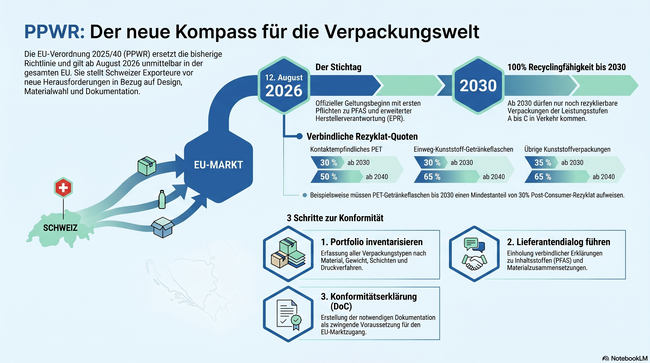
The EU Packaging Regulation PPWR (EU 2025/40) applies directly in all member states from 12 August 2026 and replaces Directive 94/62/EC. It requires binding recyclate contents, recyclability, harmonised labelling and reuse quotas – and it affects Swiss manufacturers as soon as they place packaging on the market in the EU.
With Regulation (EU) 2025/40 on packaging and packaging waste – PPWR (Packaging and Packaging Waste Regulation) for short – the European Union has created the most comprehensive legal framework for packaging to date. It replaces the previous Directive 94/62/EC. For Swiss companies supplying the EU it becomes binding from 12 August 2026. This overview summarises what the PPWR regulates, which deadlines apply and what needs to be done now.
What is the PPWR?
The PPWR is Regulation (EU) 2025/40 on packaging and packaging waste. It entered into force on 11 February 2025 and applies directly in all EU member states from 12 August 2026. It covers eight core fields:
- Plastic packaging must contain recyclate.
- Packaging must be recyclable.
- Packaging must be clearly labelled.
- Packaging must be optimised for material and space.
- Certain formats of single-use plastic packaging are banned.
- Reuse is to be promoted and is partly mandatory.
- The use of PFAS in packaging is restricted.
- Producers are to bear the costs of littering.
For Swiss companies it becomes relevant whenever packaging – on its own or as part of a product – is placed on the market in the EU.
The PPWR explained in 3 minutes
If you want the quick overview first, here is the compact explainer film on the new EU Packaging Regulation.
Watch the PPWR explainer film in under 3 minutes
Explainer film: the PPWR in under 3 minutes · Semadeni AG
Why a new regulation
The road to the PPWR was a long one. The European Commission adopted its first circular economy action plan back in December 2015 and followed up with a plastics strategy in 2018. The Single-Use Plastics Directive came in 2018 as well. With the European Green Deal in 2019 and the new circular economy action plan in 2020, packaging became a priority field of action. In November 2022 the Commission presented its proposal for a regulation; in April 2024 Parliament and Council agreed on the final text. Publication in the Official Journal followed on 22 January 2025, entry into force on 11 February 2025.
Three structural weaknesses had become apparent under the previous Directive 94/62/EC. First, member states implemented the requirements very differently – the recycling rates achieved and the design requirements diverged widely. Second, binding design requirements for recyclability and recyclate content were missing. Third, packaging waste generated per capita continued to rise, contrary to political targets.
Choosing a regulation instead of a directive is the direct consequence. An EU regulation applies without any national transposition act. From 12 August 2026 the same requirements apply in all 27 member states – the same obligations, the same basis of assessment, the same framework for sanctions.
What the PPWR regulates
Regulation (EU) 2025/40 sets requirements for the sustainability and labelling of packaging throughout its entire life cycle, including manufacture, use and waste management. It pursues three overarching objectives:
- Avoid unnecessary packaging and promote reuse, refill and recycling.
- Harmonise national measures in order to avoid barriers to trade and distortions of competition.
- Contribute to the circular economy and to climate neutrality by 2050.
The regulation organises the obligations for packaging along seven fields: substances of concern, recyclability, recyclate content, labelling, reuse, as well as waste reduction and extended producer responsibility. The following sections summarise the most important requirements.
Recyclability “at scale” by 2030
From 1 January 2030 only packaging that qualifies as recyclable may be placed on the market. Recyclability is assessed in four performance grades:
- Grade A: at least 95 per cent recyclable.
- Grade B: at least 80 per cent.
- Grade C: at least 70 per cent.
- Not recyclable: less than 70 per cent.
From 1 January 2038 grade C is excluded as well – from then on only packaging of grades A and B may be placed on the market. From 1 January 2035 recyclability must additionally be demonstrated “at scale”, meaning it must actually take place on an industrial scale rather than only in theory in the laboratory.
The specific assessment criteria will be laid down by the European Commission through delegated acts by 1 January 2028. The basis is expected to be the EN 18120 series, which CEN has been publishing as a draft series since April 2026.
Recyclate content from 2030 and 2040
Article 7 of the regulation prescribes binding minimum shares of post-consumer recyclate for plastic packaging. The quotas apply in two stages:
| Type of packaging | from 1.1.2030 | from 1.1.2040 |
|---|---|---|
| Contact-sensitive PET packaging (excluding single-use beverage bottles) | 30 per cent | 50 per cent |
| Contact-sensitive packaging made of polymers other than PET (excluding single-use beverage bottles) | 10 per cent | 25 per cent |
| Single-use plastic beverage bottles | 30 per cent | 65 per cent |
| Other plastic packaging | 35 per cent | 65 per cent |
Exempt are packaging for infant food, dangerous goods, medicinal products for human use, veterinary medicinal products, medical devices and in-vitro diagnostics, as well as compostable packaging. Also exempt from the recyclate quotas is packaging consisting of more than 90 per cent of materials other than plastic.
The calculation is carried out annually per packaging type and per manufacturing site. The evidence forms part of the technical documentation. The regulation therefore demands not only a change in material selection, but also robust master data and traceable supply chain documentation.
One key question remains open: will there be enough high-quality post-consumer recyclate in the required quality by 2030? For PET the supply situation is solid; for most other polymers – above all in food-contact quality – it is not so today. The availability and price level of recyclate will be a central bottleneck for implementing the PPWR in the years ahead.
Labelling and information
The PPWR harmonises packaging labelling across the entire EU. Three building blocks are central:
- Harmonised material composition symbol: packaging must provide information about its material composition and correct disposal via a uniform pictogram. The exact design will be laid down by an implementing act of the European Commission; application is mandatory from 12 August 2028.
- Digital labelling: QR codes and data carriers are intended to make further information machine-readable – for example on the recyclability class, the recyclate content or reuse systems.
- EU declaration of conformity: from 12 August 2026 every packaging placed on the market must be accompanied by a declaration of conformity following the template in Annex VIII of the regulation. The declaration confirms compliance with the substantive requirements (PFAS limits, substances of concern, design requirements) and forms part of the technical documentation.
For producers this means that existing artworks, printing systems and master data structures have to be reviewed and, in many cases, adapted.
Reuse, refill and re-employment
Article 29 sets binding reuse quotas in several sectors. The most important values at a glance:
| Packaging | Cross-border trade | Transport between companies within one country | Transport between sites in the EU |
|---|---|---|---|
| Pallets | 40 per cent | 100 per cent | 100 per cent |
| Strapping bands and wrappings | 40 per cent | – | – |
| Plastic boxes, trays | 40 per cent | 100 per cent | 100 per cent |
| Beverage packaging (exceptions e.g. for milk) | 10 per cent | – | – |
Anyone already using reusable packaging today must demonstrate a functioning reuse system from 12 August 2026 – that is, collection, reconditioning and return of the units.
In February 2026 the European Commission exempted pallet wraps and stretch bands from the 100 per cent reuse obligation (Art. 29(2) and (3)). A feasibility study showed that a full reuse solution for these applications is currently not achievable technically or economically.
Still exempt from the reuse targets are packaging for dangerous goods, special sizes for large-volume machinery, flexible packaging in direct contact with food and feed, as well as cardboard packaging.
Waste reduction and extended producer responsibility
The PPWR obliges member states to reduce packaging waste generated per capita step by step: 5 per cent by 2030, 10 per cent by 2035, 15 per cent by 2040 – measured against the 2018 reference year in each case.
At product level, two harmonised requirements apply from 12 August 2026: a minimisation duty for every packaging (reducing volume, weight and layers to what is functionally necessary) and a maximum empty space of 50 per cent for sales and shipment packaging.
In parallel, the regulation requires harmonised extended producer responsibility (EPR). Anyone who, as a producer within the meaning of the PPWR, first places packaging or packaged products on the market in an EU member state must register there, pay an EPR fee and participate in a system for collection, sorting and recovery. The level of the fees is increasingly differentiated according to recyclability and recyclate content (eco-modulation).
What applies from when – the deadlines
The PPWR rolls out in stages. The most important dates at a glance:
- 11 February 2025 – entry into force of the regulation (20 days after publication in the Official Journal of 22 January 2025).
- 12 August 2026 – PFAS limits in food-contact packaging (Art. 5), suppliers’ information duties (Art. 16), distributors’ verification duty (Art. 19), EPR obligations (Art. 45). The declaration of conformity by the party placing packaging on the market becomes binding.
- 12 February 2028 – empty space requirement for sales packaging (Art. 24), compostable packaging (Art. 9).
- 12 August 2028 – earliest date for the harmonised material and sorting-instruction labelling (or 24 months after adoption of the implementing act).
- 1 January 2030 – recyclability (Art. 6), start of the recyclate content obligations (Art. 7), start of the reuse quotas (Art. 29), minimisation of packaging for transport and e-commerce (Art. 24), bans on certain formats (Art. 25).
- 1 January 2035 – “recycled at scale”: recycling must actually take place on an industrial scale.
- 1 January 2038 – recyclability: market ban for grade C as well; only A and B remain permitted.
- 1 January 2040 – stage 2 of the recyclate contents (Art. 7(2)) and of the reuse targets (Art. 29).
Anyone planning packaging formats today should reckon with lead times of 12 to 24 months – for material changes, requalification, consumer testing and artwork adaptations. The 2028 and 2030 cut-off dates are closer than they look.
Who is affected
The PPWR addresses all economic operators that place packaging on the EU market or make it available there. These include:
- Suppliers of packaging and packaging components.
- Producers of packaging.
- Manufacturers of packaging and of packaged products.
- Importers bringing packaging from third countries into the EU.
- Distribution and retail, including online trade.
- Brand owners under whose name or trademark a packaging first reaches the market.
- Authorised representatives acting as the legal representation of non-EU companies.
The obligations are distributed unevenly along the value chain. Producers bear the main burden as the parties placing packaging on the market.
For Swiss companies it is decisive which role they take on under the PPWR. If, for instance, they qualify as producers within the meaning of extended producer responsibility, they must appoint an authorised representative in the EU in order to fulfil their obligations.
What the PPWR means in practice for Swiss companies
The regulation does not apply directly in Switzerland – Switzerland is not an EU member state. However, as soon as packaging or a packaged product is made available or placed on the EU market, the PPWR obligations take effect – regardless of where the company is based.
In concrete terms, the PPWR affects six internal areas of a typical Swiss company:
- Packaging development: material selection, multi-layer structure, printing processes and design templates have to be laid out for recyclability.
- Purchasing: suppliers of intermediate products, raw materials and recyclates must be able to deliver the information available to them for the subsequent declaration of conformity, which the producer has to draw up.
- Regulatory: EU declaration of conformity, EPR registrations per country, technical documentation, PFAS evidence. Different responsibilities depending on the role.
- Master data: material codes, recyclate contents, component weights and recyclability classes must be maintainable per packaging type and per manufacturing site.
- Logistics: labelling of reusable packaging and organisation of its return.
- Artwork and printing: harmonised symbols, QR code integration, adaptations to sleeves, labels and direct print.
Am I affected as a Swiss company?
In our view, four steps are a priority for companies supplying packaging or packaged products to the EU:
- Compile a packaging inventory – a complete list of all packaging types concerned, with material, weight, multi-layer structure, printing process and supply countries.
- Clarify the role matrix – define per market who places the product on the market, who carries out EPR registrations and who is responsible for the EU declaration of conformity.
- Start the supplier dialogue – clarify substance restrictions, recyclability, recyclate potential and material alternatives with your own packaging suppliers.
- Establish deadline monitoring – the outstanding delegated and implementing acts will be adopted in stages up to 2030; an internal tracking system prevents surprises.
Semadeni has been supporting Swiss companies for decades as an industrial partner for packaging – with a range that today already consists almost exclusively of mono-materials, and with advice across all six areas listed above.
Switzerland and the EU – two speeds
Switzerland does not automatically adopt EU law in the environmental field. While the PPWR applies directly in the EU from August 2026, Switzerland is running the parallel introduction of ordinances arising from the partial revision of the Environmental Protection Act (USG) and a new version of the Packaging Ordinance (VerpV).
Important Swiss initiatives outside the legislative process are already shaping operational reality today: RecyPac as a Switzerland-wide industry solution for the collection of plastics and beverage cartons, pilot projects for reusable containers in food service and retail, as well as individual companies switching their ranges to recyclable mono-materials.
In our view Switzerland does not need a one-to-one adoption of the PPWR. What it needs is a functioning circular economy for plastic packaging – with Swiss collection infrastructure, Swiss sorting capacity and Swiss reprocessing volume that make reliable recyclate available to Swiss industry.
Swiss companies supplying the EU nevertheless have to align themselves with the PPWR. Those who do so early gain twice over: access to the EU market and a head start on the Swiss market once national requirements follow.
Sources
- Regulation (EU) 2025/40 of the European Parliament and of the Council of 19 December 2024 on packaging and packaging waste, Official Journal L of 22 January 2025 – EUR-Lex 32025R0040
- European Commission, Directorate-General for Environment, Packaging waste – environment.ec.europa.eu
- European Commission, stakeholder briefing PPWR, December 2024 – slide deck on the interpretation of the regulation
- European Commission, delegated act on the exemption of pallet wraps from the reuse targets, 25 February 2026
- EUROPEN, PPWR Survival Guide, January 2025 – europen-packaging.eu
- Swiss Federal Office for the Environment FOEN, circular economy and USG revision – bafu.admin.ch
- Swiss Recycle, Forum Kreislaufwirtschaft 2025 – swissrecycle.ch
- RecyPac, industry solution for plastic packaging in Switzerland – recypac.ch
- IK Industrievereinigung Kunststoffverpackungen e.V., PPWR practical guide, February 2025 – kunststoffverpackungen.de
- Altstoff Recycling Austria AG, information on the PPWR, 10 July 2025 – ara.at
Status: May 2026. The regulation has been in force since 11 February 2025; it starts to apply on 12 August 2026. The European Commission will adopt delegated and implementing acts in stages up to 2030 to give concrete shape to the obligations.