
Capability · Tool & mould
Mould making & tooling
Injection moulds from our own mould shop in Switzerland – mould design, Moldflow analysis, sampling as well as mould maintenance and storage. The parts that come out of the finished mould are produced next door in our own injection plant.
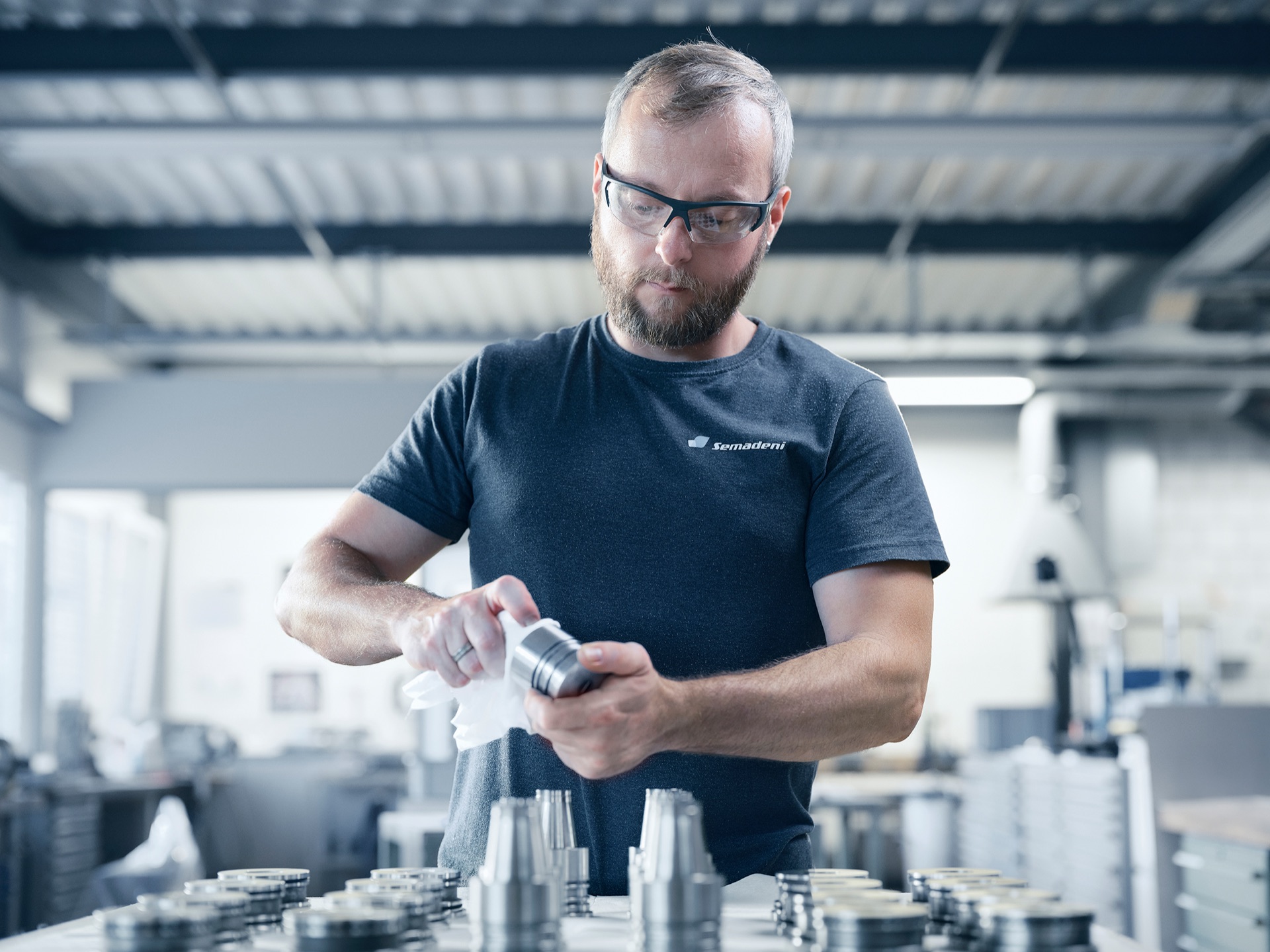
Who builds injection moulds in Switzerland?
Mould making (tooling) is the design and manufacture of the injection moulds with which plastic parts are later produced in series. Semadeni runs its own mould shop in Ostermundigen: CAD part and mould design, Moldflow analysis to simulate filling behaviour and warpage, building and testing the mould, sampling with a first-article inspection report (FAIR), and maintenance, repair and storage of the mould – under our general terms (clause 9.5) for five years from the last delivery, and longer on request against cost. What we build ourselves is mainly smaller moulds; the larger share of the work in our own mould shop is repair and upkeep. Larger moulds are built by external mould-making partners, always in close coordination with us – which keeps us responsive and gives us the capacity for large projects too. Existing customer moulds are taken over, measured and reconditioned. Whether a dedicated mould pays off is clarified per project based on quantity, geometry and material – for small volumes, CNC machining or 3D printing is often the more economical bridge. Series production from the released mould is described on the injection moulding page.
Process
Benefits of Mould making & tooling
Mould and series in the same place
Mould shop and injection plant sit in the same hall – the mould is tested where it will later produce, and corrections run without changing supplier.
In-house mould shop
Design, machining on our own CNC machines and testing on our own premises – mainly for smaller moulds and for repair and upkeep, with short iterations and direct control of quality.
Partners for large moulds
Larger moulds we build with established mould-making partners, always in close coordination with us – so capacity and response time stay plannable on large projects as well.
Moldflow before the steel
Simulation of filling behaviour, weld lines, sink marks and warpage before the mould is built – saving later corrections on the steel mould.
Prototyping as a bridge
Concept and functional samples from CNC milling or 3D printing verify geometry and fit before mould costs arise.
Mould care & storage
Maintenance, repair and storage of customer and in-house moulds – for plannable repeat series over years.
Takeover of existing moulds
We take over moulds from another manufacturer, measure them, recondition them and put them into operation – the mould stays your property.
Technical possibilities
Framework for pre-clarification. Mould concept, cavity count and economics are defined per project based on part, material and the planned series.
From CAD to the released mould
Part design
CAD design, material selection and injection-friendly design consulting.
Moldflow analysis
Simulation of filling behaviour and warpage before mould building.
Mould building
Building and testing the mould – in our own mould shop or at a mould-making partner.
Sampling & release
First samples with inspection report – this is where mould making ends and the series begins.
Mould care
Maintenance, repair and storage – under our terms, clause 9.5, for five years from the last delivery, longer on request.
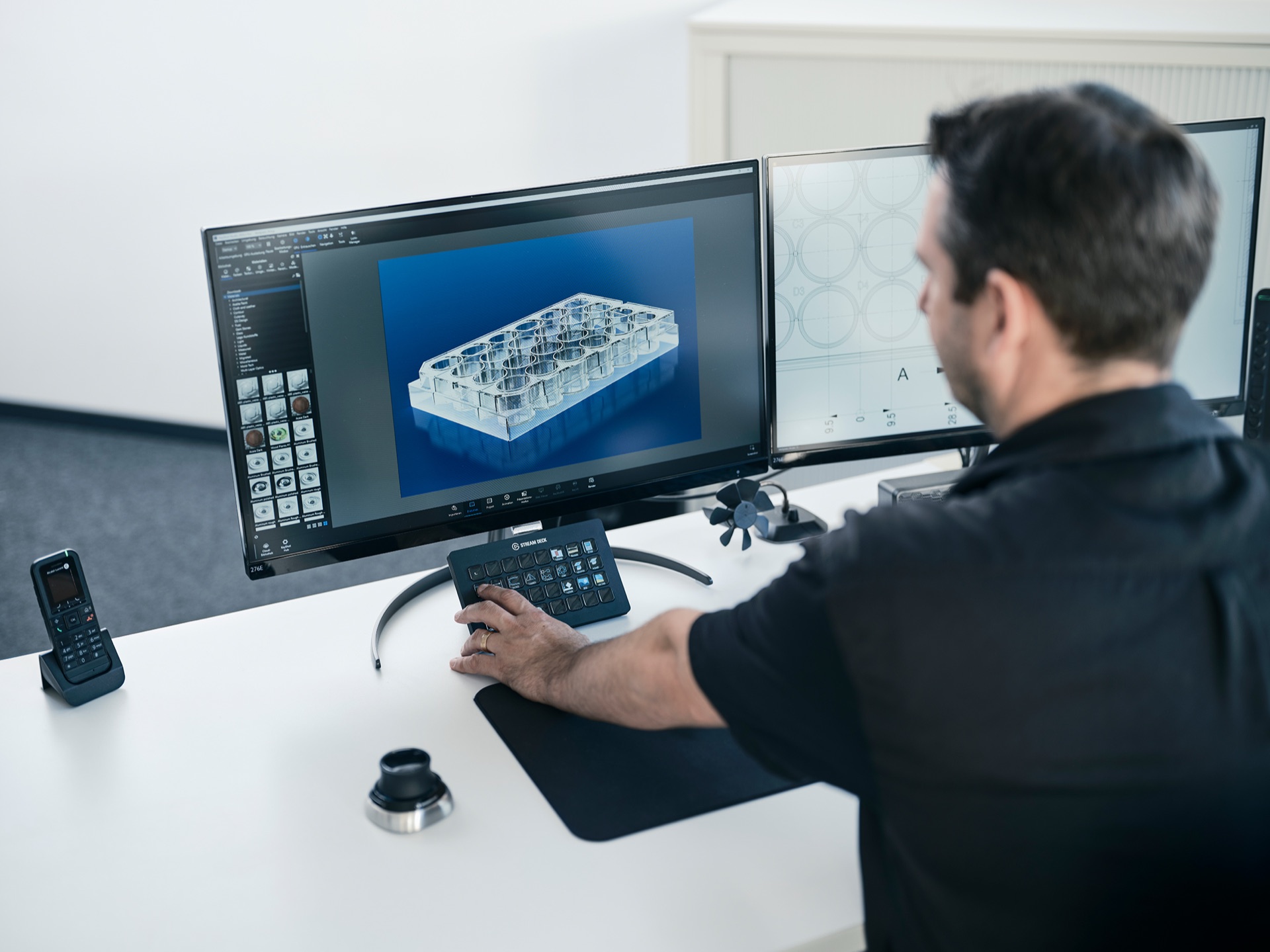
Before the mould
Prototyping with CNC and 3D printing
Before a steel mould is made, we verify geometry, fit and function on milled or 3D-printed samples. Changes can thus be incorporated early and cheaply – long before mould costs arise.
- Concept and functional samples directly from the CAD data
- Rapid iteration of several variants up to the design freeze
- Seamless transition from the released sample into mould making
For which tooling projects?
- A new mould for a newly developed part
- A follow-up or replacement mould for a running series
- Takeover and reconditioning of an externally built mould
- Modification or extension of an existing mould (cavities, gating, contours)
Build a mould or machine?
In detail
Mould making that fits the series
An injection mould is the most expensive and most durable investment of a plastics project. Semadeni designs and builds moulds in its own mould shop, thinking the series through from the start – from wall thickness through demoulding to cooling. The result is a mould that not only delivers the first sample but reproducible parts over years.
In-house mould shop and partners
Where the mould is built
Our own mould shop in Ostermundigen mainly produces smaller moulds; the larger share of the work there is repair, maintenance and upkeep. Larger moulds we build with external mould-making partners – always in close coordination with us, so that design, sampling and later care stay in one hand. That keeps us responsive on large projects and gives us the capacity we need.
Simulation before the steel
Why Moldflow pays off
Before steel is removed, we simulate the injection process. The Moldflow analysis shows weld lines, sink marks, filling behaviour and warpage on the model – where gate position, wall thicknesses and cooling can be adjusted while changes only cost data. Corrections on the finished mould, by contrast, are laborious and expensive.
From prototype to mould
A bridge for small volumes
Not every part needs a mould immediately. For functional samples and small quantities we manufacture by CNC milling or 3D printing and verify geometry and fit on the real part. Only after the design freeze is steel cut – by then the geometry is settled and the mould does not have to be corrected afterwards.
The mould across its lifetime
Maintenance, storage, takeover
A mould is a piece of production equipment, not a one-off purchase. We store customer and in-house moulds, clean and maintain them at agreed intervals and recondition wear parts, so that repeat series stay plannable over years. Under our general terms (clause 9.5), storage, care and insurance apply for five years from the last delivery; on written request we extend that period against cost. Moulds from another manufacturer are equally welcome: measured, condition-checked, reconditioned, sampled, released.
What comes afterwards – series production, machine park, cleanroom, materials and quality assurance on the part – is described on the injection & contract moulding page.
Frequently asked questions about Mould making & tooling
Does Semadeni build every mould itself?
No. Our own mould shop in Ostermundigen mainly produces smaller moulds; the larger share of the work there is repair, maintenance and upkeep. Larger moulds and large projects we realise with external mould-making partners, always in close coordination with us – which gives us capacity and short response times even where a project exceeds our own mould shop. It does not change who your contact is: design, sampling, release and mould care all run through us.
What is a Moldflow analysis?
A simulation of the injection process in the mould. It predicts weld lines, sink marks, filling behaviour and warpage before the mould is built. Gate, wall thicknesses and cooling can thus be optimised – saving expensive corrections on the finished steel mould.
From what quantity is an own mould worthwhile?
The mould investment pays off over the series through low unit costs; a dedicated mould typically becomes economical from around 1,000 pieces, depending on part and mould effort. For smaller volumes we recommend CNC machining or 3D printing as a bridge solution.
Who owns the mould that Semadeni builds?
A mould we build remains Semadeni's property under our general terms (section 9) – even where you have covered part or all of the tooling costs. We use it exclusively for your orders, store it and maintain it. If you bring your own mould, it stays your property and is marked as third-party property. Any departure from this is set out in writing in the quote.
Can Semadeni take over an existing mould from another manufacturer?
Yes. We receive the mould, measure it, check the condition of cavities, ejectors and cooling, and recondition it where needed. Sampling for release follows, after which the mould enters our regular mould-care programme.
How long does an injection mould last?
Service life depends on the mould steel, part geometry, material (particularly filled or abrasive grades) and the number of shots. Regular maintenance and cleaning are decisive for a long tool life – both are part of our mould service, with intervals defined per project.
What information does Semadeni need for a mould quote?
A drawing or 3D model of the part, the material or requirement, the planned annual and total quantity as well as details on tolerances, surface finish and any standards are helpful. Quantity and cycle time determine a sensible cavity count, part and series determine the gating system – the more specific the details, the more reliable the mould concept.
Continue in the cluster
- ProcessView
Injection & contract moulding – the series from the mould
Injection-moulded parts in series from our own plant in Switzerland – clamping forces from 22 to 180 t, an ISO 7 cleanroom, technical and food-grade thermoplastics. As contract moulding on your tool, or on a tool from our own mould shop.
- SolutionView
Industry & manufacturing
Plastic solutions for industry, mechanical engineering and trade: spill pallets, containers, cut-to-size semi-finished products and special constructions in PP, PE, PVC-U and other technical thermoplastics – custom manufacturing to drawing from batch size one, from Swiss production in Ostermundigen.
Request a mould concept
Send a drawing or sample, the desired material and the planned annual quantity. We check feasibility, propose a mould concept with cavity count and gating system, and prepare a quote – personally from Switzerland.