
Capability · Marking & cutting
Laser engraving & laser cutting
Laser engraving and laser cutting of plastics – for markings, signs, logos and fine contours. Semadeni runs CO₂ laser technology mainly for acrylic glass (PMMA), from a single part and from your vector file.
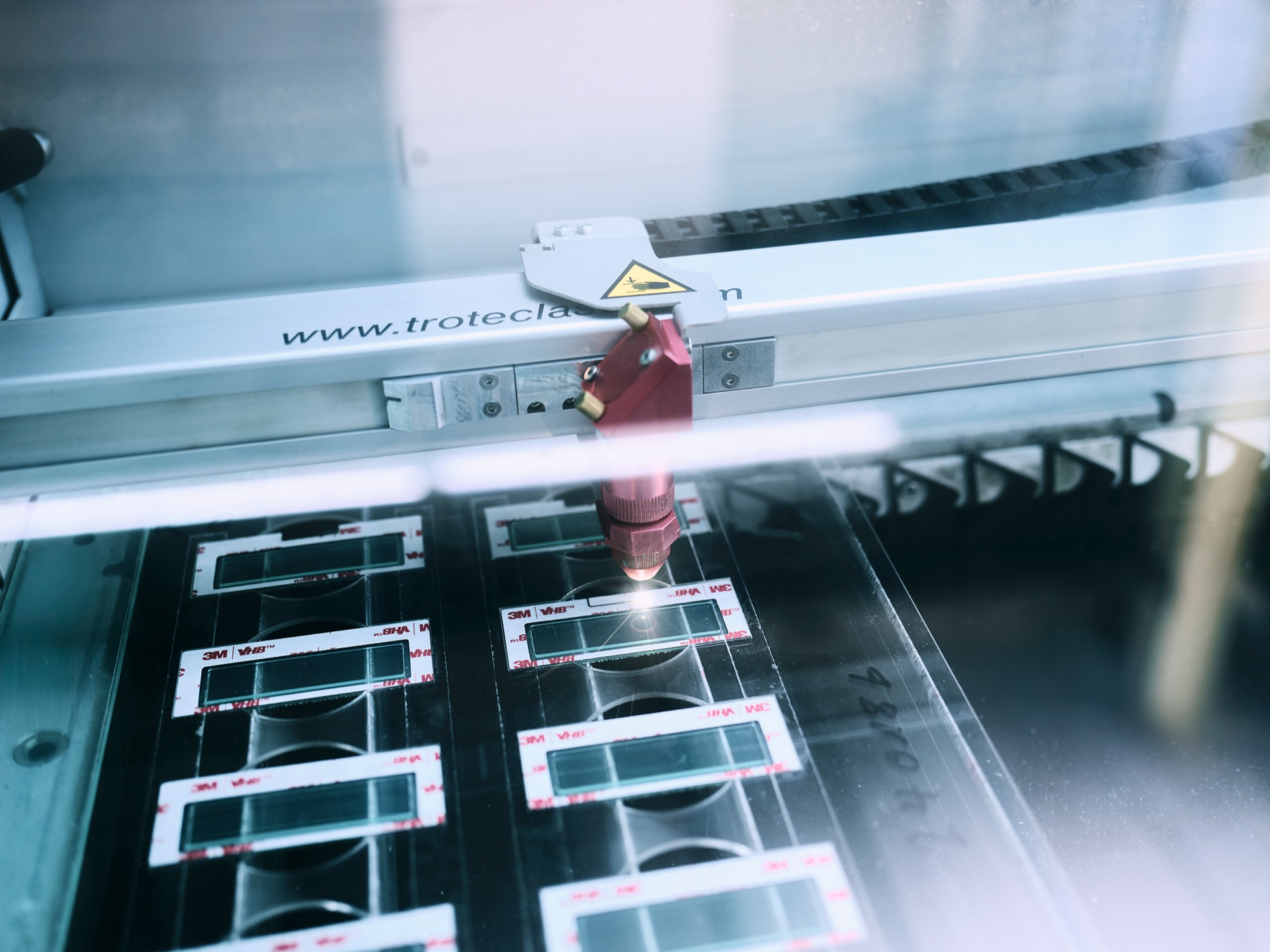
What does Semadeni offer in laser engraving and laser cutting of plastics?
Laser engraving and laser cutting are contact-free processes in which a focused CO₂ laser beam removes plastic – to mark (engraving) or to separate fine contours (cutting). Semadeni engraves durable markings, logos and scales and cuts internal cut-outs, perforations and complex outlines from sheet material. Because no tooling is required, the process is worthwhile from a single part and for variable data such as serial numbers. On PMMA, cutting produces a polished, crystal-clear edge with no post-processing; engraving removes the material itself and is therefore abrasion- and wipe-resistant. Not every thermoplastic can be lasered: Semadeni works almost exclusively with acrylic glass (PMMA) on the laser, and additionally with wood and stone for engraving; other materials on request. We do not process PVC on the laser. Which combination of power and speed suits your material and sheet thickness we define per project based on material, thickness and the desired edge quality.
Process
Benefits of Laser engraving & laser cutting
Tool-free from a single part
Without a punching or cutting tool we already produce single parts and small series economically – including variable data such as consecutive numbers.
Durable marking
The engraving removes the material itself – no paint, no glue. The marking stays wipe-, abrasion- and cleaning-resistant for the life of the part.
Polished cut edge on PMMA
Acrylic glass gets a crystal-clear polished edge straight from the laser, with no milling or polishing – ideal for visible display and design parts.
Fine, complex contours
Internal cut-outs, perforations and filigree geometries can be cut in a single pass that a mechanical tool cannot reach.
A vector file is enough
You supply a drawing as DXF, SVG or PDF – we prepare the file ready for the laser and sample beforehand if required.
Combinable from one source
Cutting, engraving and subsequent CNC machining or assembly come together at Semadeni on the same site.
Technical possibilities
Framework for pre-clarification. Power, speed and focus are matched to material, sheet thickness and the required edge quality.
From file to part
Data check
We check your vector or image template for laser suitability and material.
Material choice
Match material and sheet thickness – to the marking or cut quality.
Sampling
If required, a sample for contrast, edge and fit before the series.
Production & finish
Engraving or cutting, cleaning and, on request, further processing.
What are laser & engraving suited for?
- Nameplates, scales and durable device markings
- Logos, display and advertising parts in polished acrylic glass
- Stencils, masks and technical cut-outs from sheet material
- Small series with variable data such as serial or batch numbers
Laser or milling?
In detail
Marking and cutting with light
The CO₂ laser works contact-free: a focused beam removes plastic exactly where the template prescribes – without tooling, without mechanical forces and without wear on the workpiece. This makes the process equally suited to the durable marking of a nameplate and to the filigree cutting of a stencil. You supply a vector file, we realise it ready for the laser.
Two processes, one system
Laser engraving and laser marking
In laser engraving, the laser removes the top material layer and thus creates text, logos, scales or raster images directly in the plastic. This laser marking is predestined for nameplates and device identifications in industrial use. Because neither paint nor glue is involved, the marking stays wipe- and cleaning-resistant. On dark materials a light, high-contrast result is produced.
Cutting
In cutting, the beam separates the material completely – including fine internal cut-outs, perforations and complex outlines that a mechanical tool cannot reach. Acrylic glass thereby gets a polished, crystal-clear cut edge that is ready for use without post-processing.
Material decides the result
Not every plastic can be lasered. On the laser we work almost exclusively with acrylic glass (PMMA) – it delivers the best edge quality; wood and stone are also suitable for engraving. Other materials we assess on request. We do not process PVC on the laser, because cutting it releases hydrogen chloride. Which combination of power, speed and focus suits your material and sheet thickness we match before production and sample if required.
Frequently asked questions about Laser engraving & laser cutting
Which file formats does Semadeni accept for laser jobs?
For cuts and engravings, vector data is best: DXF, DWG, SVG, AI and PDF (as vector). For raster engravings we also take JPG or PNG, ideally from 300 dpi. If only a sketch exists, we prepare the template ready for the laser against effort.
Can PMMA be laser-cut?
Yes, and with a characteristic advantage: the cut edge of acrylic glass is polished and crystal-clear after laser cutting, without milling or polishing. This makes the laser the first choice for visible display, design and advertising parts in PMMA.
Is a laser marking durable?
Yes. The engraving removes the material itself and works without paint or glue. The marking therefore stays wipe-, abrasion- and cleaning-resistant. On dark materials a light, high-contrast result is produced.
Which plastics can be lasered?
Not every thermoplastic can be lasered. On the laser we work almost exclusively with acrylic glass (PMMA); wood and stone are also suitable for engraving. Other materials we assess on request. We do not process PVC on the laser – cutting it releases hydrogen chloride. The power and speed a material tolerates depend on type and thickness; we clarify suitability per product and material.
From what quantity is laser cutting worthwhile?
Because no tooling is required, the laser is economical from a single part and especially flexible for variable data or frequent changes. For very large quantities of identical parts, punching or injection moulding can be cheaper – we examine this per project.
Continue in the cluster
- CapabilityView
CNC machining & cutting
Precision plastic cutting to size and CNC machining – for single parts, small batches and standard formats. Semadeni machines acrylic, PP, PE, PVC, PC and all common thermoplastics from batch size one.
- CapabilityView
Thermoforming & bending
Thermoforming, thermal bending and laminating (acrylic pressing) of plastic sheets to size. Semadeni forms acrylic glass, PP, PVC and other thermoplastics from template, tool or CAD data – from single part to small series.
- SolutionView
Industry & manufacturing
Plastic solutions for industry, mechanical engineering and trade: spill pallets, containers, cut-to-size semi-finished products and special constructions in PP, PE, PVC-U and other technical thermoplastics – custom manufacturing to drawing from batch size one, from Swiss production in Ostermundigen.
Send your file – we laser your part
Send us your vector file or sketch, the desired material and the quantity. We check laser suitability, sample if required and prepare a quote – personally from Switzerland.