
Market & regulation
Sales, grouped and transport packaging under the PPWR – what counts as packaging from 2026
Sales, grouped or transport packaging? The PPWR, applicable from 12.8.2026, requires correct classification. What counts as packaging and what companies need to check.

In brief
With the EU Packaging Regulation directly applicable from 12 August 2026 (PPWR, Regulation (EU) 2025/40), a fundamental compliance question takes on new significance: what actually counts as packaging in legal terms? The answer is not always obvious. In borderline cases in particular, courts and authorities are increasingly dealing with the distinction between packaging and product component.
For producers, importers and distributors of packaging and packaged products in the EU single market, as well as for Swiss exporters to the EU, correct classification is decisive. Anyone who wrongly fails to classify an item as packaging risks errors in declarations of conformity, labelling duties, recycling requirements, data reporting or national EPR obligations such as packaging licensing. From the perspective of packaging practice, the requirements of the packaging definition under Art. 3 PPWR and the distinction between sales, grouped and transport packaging are therefore essential knowledge for those responsible for compliance. You will find a complete overview of the PPWR obligations in our overview article on the EU Packaging Regulation.
When an item counts as packaging
Art. 3(1)(1) PPWR defines packaging as items intended to contain, protect, handle, deliver or present products. Whether an item actually counts as packaging is not, however, decided on the basis of a single characteristic.
In our practice the following questions have proven useful for classification. You will find an applicable working aid in our PPWR checklist on the packaging definition.
The six test questions on the packaging definition
1. Does the item perform a typical packaging function?
For the packaging definition under Art. 3 PPWR it is sufficient if an item serves to contain, protect, handle, deliver or present a product. Annex IV Part A PPWR specifies these purposes by means of various performance criteria, including:
- Product protection (protecting the contents against damage or contamination)
- Support of filling, closing or production processes
- Logistics (distribution, transport, handling and storage of the packaged product)
- Labelling and information
- Presentation and sale
- Hygiene and safety (safe handling and user protection)
Just one of these purposes can be enough for classification as packaging.
2. Is the item passed on along the supply chain?
Practical example: a wide-neck jar that contains a product and is delivered to end users typically meets this condition. The assessment may be different for a container used for retained samples. Although it looks similar, it does not serve to deliver a product along the supply chain, but rather internal quality assurance.
This example makes clear that material or shape alone do not decide the classification. Two outwardly identical containers can be assessed differently depending on the context of use.
3. Would other packaging be required without the item?
If the function of the item suggests that other packaging would otherwise have to take over containing, protecting, handling, delivering or presenting the product, this regularly points to packaging.
4. Can the product exist without this item?
If the item is not an inseparable component of the product, this points to packaging. If, however, the item is indispensable for the function of the product (e.g. water-soluble films for dishwasher detergent), it is not packaging.
5. Is there an identifiable packaging unit?
What is decisive is whether the item is used as packaging in its final form. A filled beverage bottle with closure and label is a finished packaging unit. A PET preform, by contrast, is not yet packaging but an intermediate product for the later manufacture of packaging.
6. Can the item be assigned to a packaging category?
Is it a sales, grouped or transport packaging? If the item cannot be assigned to any packaging category, this regularly speaks against packaging within the meaning of the PPWR.
If all questions can be answered yes, the item should in principle be regarded as packaging within the meaning of the PPWR and subsequently assigned to sales, grouped or transport packaging.
Indicative lists in Annexes I and II of the PPWR
Annex II lists in Table 1 examples of formats that can count as packaging. Annex I of the PPWR contains an indicative list of items that can typically be classified as packaging. Inclusion in this list alone is not sufficient, however. As the European Commission expressly clarifies in its guidelines on the PPWR, the conditions of the packaging definition under Art. 3(1)(1) PPWR must additionally be met. The specific function of the item in the respective context of use therefore always remains decisive.
Typical source of error: in practice, items are frequently assessed by their shape alone. For the PPWR, however, what matters is the function they perform in the supply chain. Two outwardly identical containers can therefore be classified differently.
Rule of thumb: for the PPWR it is not the shape of an item that decides, but its function within the supply and use chain.
An item regularly counts as packaging within the meaning of the PPWR if it is passed on along the supply chain, performs at least one packaging function, is not an integral part of the product, exists as an independent packaging unit and can be assigned to a packaging category.
Sales, grouped and transport packaging – the three core categories of the PPWR
Not every packaging performs the same function in the supply chain. The PPWR therefore distinguishes between sales, grouped and transport packaging. These three categories form the basis of numerous regulatory obligations.
Sales packaging
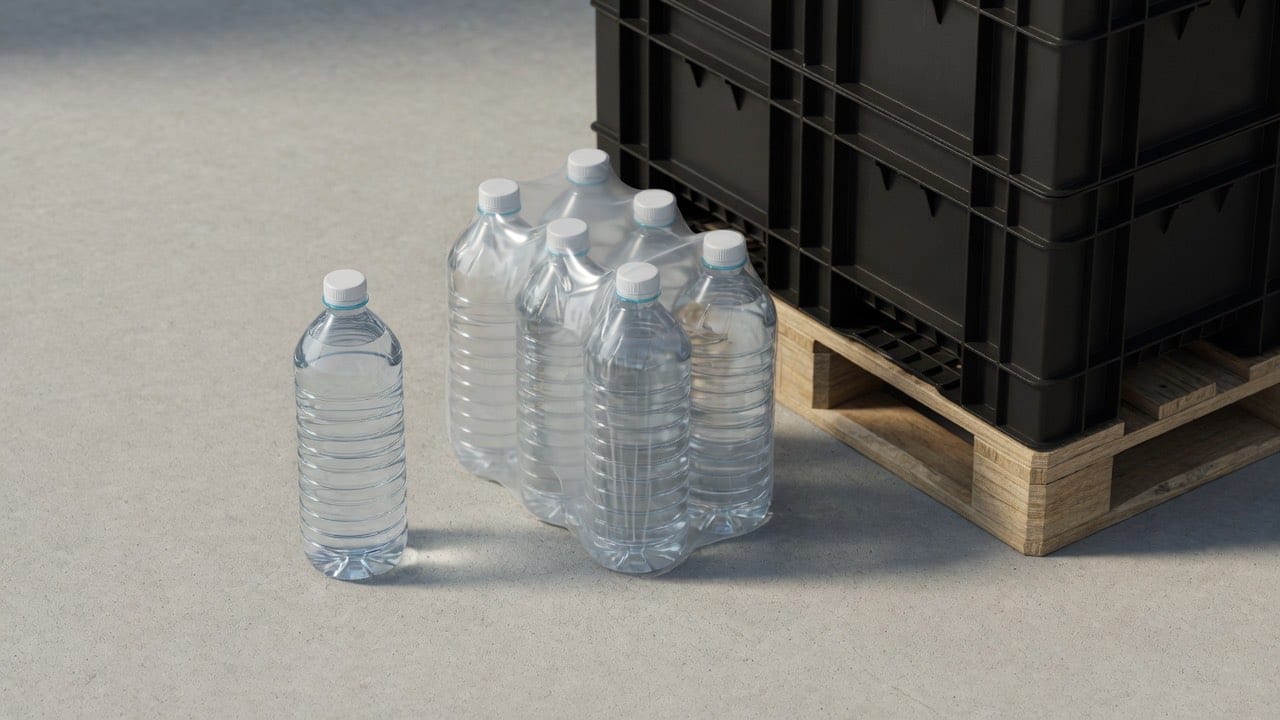
Sales packaging is handed over to the end user together with the goods. It forms the sales unit that consumers purchase in retail.
Typical examples are PET beverage bottles, cosmetic jars or yoghurt pots.
Grouped packaging
Grouped packaging combines several sales units. It can be removed without altering the properties or functions of the individual products.
Classic examples are sleeves around beverage multipacks, film packaging for promotional offers or folding boxes that bundle several tubes or containers.
Transport packaging
Transport packaging facilitates the handling and transport of several sales or grouped packagings along the supply chain. It primarily serves to protect the goods during storage, handling and transport.
Typical examples are industrial containers such as Craemer pallet boxes or IBC containers on plastic pallets, as well as stretch films for load securing.
Further packaging categories under the PPWR
The PPWR additionally introduces further types of packaging that are relevant for individual sectors. These include in particular service packaging, for example take-away cups or meal boxes such as bio cups made of kraft paper/PLA, as well as primary production packaging, such as packaging for raw materials from agriculture and forestry like E1–E3 containers.
For those responsible for compliance, however, reliable classification as sales, grouped or transport packaging remains a decisive step. Numerous labelling, notification and reporting duties along the entire value chain depend on this classification.
When something is not packaging – integral product component, dual-use item or packaging material
Not every item that contains or protects a product automatically counts as packaging. The PPWR names three case groups in particular that regularly lead to misclassification in practice.
Integral product components
Packaging must be distinguished from what is an integral part of the product. An item does not count as packaging if it remains necessary for the function of the product throughout its entire lifetime.
Typical examples are water-soluble films for dishwasher detergent, the wax layer around cheese or the casing of certain meat products.
Dual-use items
Some items may or may not be packaging, depending on how they are used.
What is decisive is whether the item is intended and correspondingly designed for filling at the point of sale. Single-use cups, single-use plates and mugs, cling films, bread bags or plastic films for cleaned garments in laundries can be packaging if they serve to deliver goods. A PP drinking cup or a polypropylene flap bag can therefore be classified as packaging or as an ordinary product depending on its use. What matters for classification is not the product designation, but the intended purpose of use.
Packaging material or packaging component is not yet packaging
Individual packaging materials or packaging components do not yet meet the packaging definition.
For companies this means: preforms and packaging materials such as PET preforms or films on rolls are not yet finished packaging units. The assessment is only carried out on the packaging in its final composition. This is also expressly clarified in the European Commission’s FAQ on the PPWR (Chapter XV.5).
Is this packaging?
In packaging practice it is not the shape of an item that decides, but its function in the supply chain. Whether cup, bag, film or container: what is decisive for classification under the PPWR is which task the item performs in the specific context of use.
The following overview summarises the examples that this article explains individually above. It is neither exhaustive nor does it replace the case-by-case assessment.
| Item | Packaging under the PPWR? | Reason |
|---|---|---|
| Water-soluble film for dishwasher detergent | No | Becomes part of the product during use |
| Wax layer around cheese | No | Integral component of the product |
| Sausage casing | No | Product component under the PPWR distinction |
| Bread bag at the point of sale | Yes | Serves the handing over and taking away of goods |
| PET preform for bottles | No | Packaging material, not yet a finished packaging |
| Container for retained samples | Depends on the individual case | Serves internal quality assurance, not the delivery of a product along the supply chain |
Packaging components and packaging aids – what belongs to them
In practice, packaging rarely consists of a container or box alone. Closures, labels, sleeves or dosing aids perform important functions and often shape the properties of the packaging just as much as the main packaging itself.
Product component or packaging component
The PPWR draws a clear distinction between product components and packaging components. Items that remain necessary for the function of a product throughout its entire lifetime are not packaging. These include, for example, certain water-soluble films for dishwasher detergent.
The situation is different for components that perform the function of the main packaging together with it. Screw closures, adhesive labels or dosing aids regularly do not constitute independent packaging in themselves. They do, however, count as components of the packaging and are assessed together with the finished packaging unit. For purchasing and packaging development this distinction is particularly important, since the regulatory requirements always target the finished packaging in its actual composition.
Components that are removed before or during use also remain part of the packaging. Typical examples are sealing films on food packaging or sterile barrier systems in the medical field.
Packaging aids and packaging material
Packaging aids such as packing tapes, strapping bands or air cushions play a special role. As long as they exist separately from a packaging, they are packaging material. Only through their use do they become a component of the respective packaging. Label rolls also fall into this category.
Correct classification of packaging components and packaging aids is an important prerequisite for the subsequent conformity assessment under the PPWR.
What companies have to check now – declaration of conformity and roles under the PPWR
For many companies, PPWR compliance does not begin with recycling quotas or labelling requirements, but with a considerably more fundamental question: which items in their own range count as packaging at all?
Three-step check for PPWR compliance
Step 1: identify packaging
First check which products and components meet the PPWR packaging definition. Particularly with cases, containers, trays, films or special applications, a systematic case-by-case review is worthwhile. For a structured assessment in individual cases you can use our PPWR checklist on the packaging definition. As practical orientation, the ZSVR catalogue of packaging subject to system participation can serve, which many companies already know from the German Packaging Act. The authoritative assessment is, however, always made on the basis of the PPWR.
Step 2: assign packaging correctly
The next step is to determine whether it is a sales, grouped or transport packaging. This classification is not a mere formality. It influences numerous further PPWR requirements, including reporting duties, recyclate requirements, substance requirements and reusability requirements.
Step 3: clarify roles and evidence
Once the packaging has been identified and classified, companies should document their responsibilities along the supply chain. This includes clarifying the respective role as producer, manufacturer, importer, distributor or supplier. This determines who bears responsibility for the declaration of conformity (DoC) under Art. 11 PPWR.
Practice shows that misclassifications frequently do not arise with complex recycling requirements, but already with the question of whether an item counts as packaging at all. A clean classification therefore forms the basis for all further compliance steps.
With preforms and packaging materials such as PET preforms or films on rolls it should also be noted that the regulatory assessment is regularly only carried out on the finished packaging unit.
Our role as supplier and your responsibility under the PPWR
The PPWR distinguishes different roles along the supply chain. Semadeni generally supplies packaging, packaging components or packaging materials such as containers, bottles, canisters, cups or closures. Within the meaning of the PPWR we therefore regularly act as a supplier.
As a supplier we make available to our customers the information and documents available to us that they need for their regulatory obligations. These include, for example, technical specifications, material information or available evidence on the materials used.
Central responsibility lies, however, with the company that develops the packaging or has it manufactured, or that places the packaged product on the market under its own name. According to the European Commission’s interpretation, this is frequently the filler or brand owner.
The producer is responsible in particular for:
- Conformity assessment of the packaging
- Technical documentation
- Declaration of conformity (DoC)
- Compliance with the PPWR requirements
- Evidence of recyclability
- Evidence of recyclate content
- Compliance with substance requirements and minimisation requirements
Important note for our customers: Semadeni generally does not know the specific use of the products ordered. Whether a container, cup, canister, bag or film is to be classified as packaging within the meaning of the PPWR in a specific application depends on the actual use.
Before concluding a contract and before placing on the market, the customer is responsible for
- reviewing the intended use,
- carrying out the classification as packaging or non-packaging,
- determining its own role under the PPWR, and
- ensuring that the packaging used complies with the applicable PPWR requirements.
If products are to be used as packaging within the meaning of the PPWR, we recommend coordinating this with us at an early stage.
Do you need support?
We are happy to support you with questions on:
- Packaging or non-packaging
- Sales, grouped and transport packaging
- Roles under the PPWR (producer, supplier, importer, distributor)
- Technical product information
- Material and recycling information
Conclusion: the packaging definition is the basis of PPWR compliance
Rule of thumb: whether an item is packaging is decided not by its designation, but by its function within the supply and use chain.
With the PPWR, the question of what counts as packaging becomes a central compliance task. Classification starts with the question of whether an item is to be regarded as packaging within the meaning of the PPWR at all. Next it must be determined whether it is a sales, grouped or transport packaging. Numerous further obligations along the value chain depend on this classification.
From the perspective of packaging practice, an early review of existing product and packaging concepts is worthwhile. Those who assess borderline cases correctly create the basis for legally sound implementation of the PPWR.
You will find a complete overview of all requirements, deadlines and obligations in our overview article on the EU Packaging Regulation (PPWR).
Further articles on the PPWR
- PPWR – the EU Packaging Regulation 2026 at a glance
- PFAS in packaging under the PPWR – what applies to producers from 12.8.2026
Note: the contents of this article serve general information purposes and do not constitute legal advice. The examples and classifications presented reflect our practical experience as a packaging supplier. The classification of an item as packaging within the meaning of the PPWR always depends, however, on the specific purpose of use and the circumstances of the individual case. The legal provisions applicable in each case, and their interpretation by authorities and courts, are authoritative.
Sources
- EUR-Lex – Regulation (EU) 2025/40 (PPWR)
- European Commission guidelines C(2026) 2151 final of 30.03.2026
- European Commission FAQ of 30.03.2026
- ZSVR – catalogue of packaging subject to system participation
- ZSVR – overview of selected court decisions on the packaging definition
- IK PPWR practical guide, edition 1, February 2025
- ARA information on the PPWR, status 10.07.2025